
Self-efficacy is the concept which defines one’s belief in themselves to traverse the challenges that present themselves.
Said more plainly – self-efficacy is whether or not you believe you will be successful in a given situation.
If you want to do a quick check on your self-efficacy think of your private, internal self-talk. The last fifteen months of your life were challenging, but did you say things to yourself like, “This is going to be rough, but I am the right person to lead my building through this difficult time” or “Remote learning stinks for everyone, but I am going to make it work for my kids.” If that was your self-talk, then you probably have strong self-efficacy. If your self-talk skewed negative and was a true reflection of how you felt, then maybe your self-efficacy could use a boost.
The research on the power of both self- and collective-efficacy and its impact on schools is abundant. That, however, is not where I am going with this. I want to think about a question a few levels deeper than that. If we all know self-efficacy is good and it seems perfectly rational that we would all want to have self-efficacy, then what is it that we can do to intentionally increase our self-efficacy?
While it seems as though some people are born with an irrationally highly belief in themselves, I believe that if we take our time, we can better understand what it is that provides the substance behind the swagger – that is, when that substance truly exists.
The key to growing our self-efficacy is remaining unfinished.
The key is to not simply “just be” and remain stagnant, but to be focused on what you are becoming. This is harder than it sounds. We must trust in two things to do it right. First, remind yourself growth is not linear.
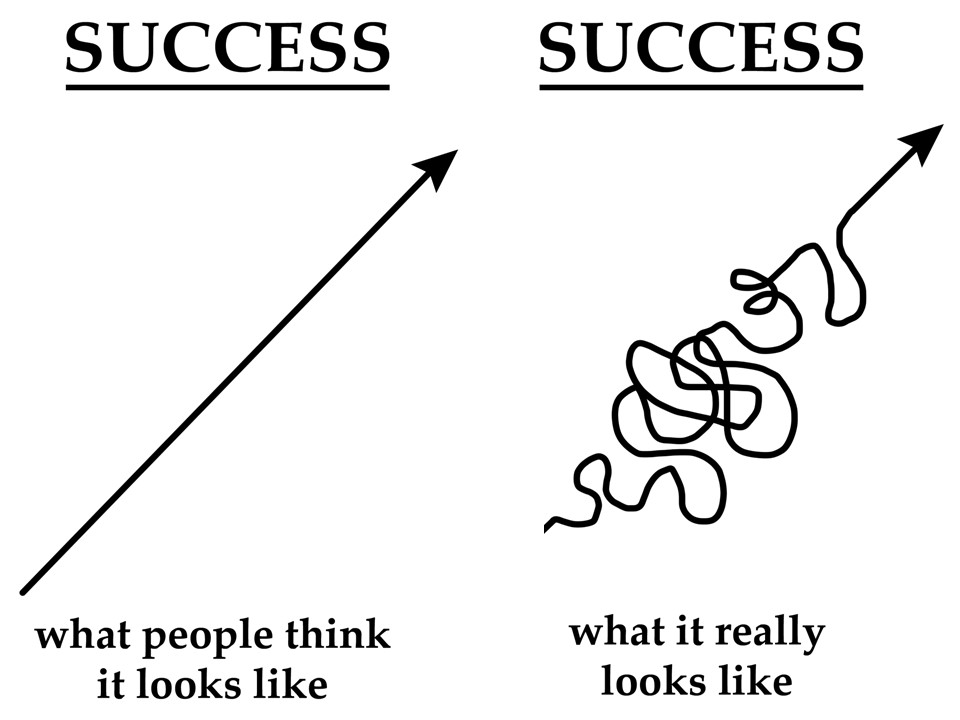
Second, in order to significantly and strategically increase our own self-efficacy and capacity, we have to take inventory of where we currently are.
Can you define your POINT A so that you can start to plot your journey to POINT B?
The ten questions below are a starting point. My hope is that you really sit with these questions. Let them wash over you. Think. Take your time. Digest one of them on your run and another in the shower and one more on the drive to work with the radio off.
Seriously. Really take inventory.
To steal a catchphrase from one of my favorite authors, Keith J Cunningham, NOW GO THINK, YOU WILL THANK ME LATER.
1. What is the single greatest lesson you have learned in the past 15 months and how will it impact you moving forward?
2. What are your biggest strengths? Are you sure your supervisor would agree? How about the people you serve?
3. Do you believe you can be the best teacher/principal/superintendent in your region? Why or why not? What have you intentionally done to put yourself on that path?
4. What do you fear when thinking about professional advancement? Where do you think that fear originates?
5. What is one thing you wish your direct supervisor remembered (or still considered) about that role? Have you considered just having a direct, non-emotional conversation with that person about this topic?
6. What kind of teammate are you? Do you help your peers grow? Do you let your peers help you grow? Do you thoughtfully reach out to check on their social-emotional status?
7. What is YOUR vision for where you want your classroom/building/district to go AND/OR education to go? Can you communicate this in a clear and compelling manner? Would the people you serve be able to tell me your vision if I were to ask – why or why not?
8. What is your work-life balance now in comparison to year 1 in your current profession? Is the job getting easier or less demanding? If not, what are you doing to re-prioritize or become more efficient?
9. Cultures of classrooms, buildings, and districts are intentionally and thoughtfully built. How are you building culture on a daily basis? Culture is also a reflection of the MOST toxic behavior regularly allowed to occur in your class/building/district., With that in mind, what conversations do you need to have immediately?
10. What is one thing you REALLY need to be honest with yourself about? What is the one thing that you have been avoiding telling yourself for some time that significantly impacts your professional growth?
This year has been tough. I am proud to be an educator and a leader that has helped propel our schools forward through this trying time. You should feel that same pride. Give yourself some grace. Believe in yourself. Take inventory. Move forward.
Special thanks to my friend and colleague Joe Mullikin in helping me by being my thought-partner in the creation of these questions.
THE BEST THING I READ/WATCHED THIS WEEK
Employees Are More Likely to Pretend They’re Working When Employers Track Their Productivity: Here’s Why
— Kristin Stoller from Forbes
“We shouldn’t do things just because it seems right or seems like the best practice,” she says. “We really need to be intentional in how we are managing these workforces, whether they are remote, hybrid or in person.”
THREE PEOPLE YOU SHOULD KNOW

THOMAS MURRAY

DOUG ROBERTS

SCOTT WHIPPLE
WHERE YOU CAN FIND ME SOON
ON DEMAND – Manage Your Time or Time Will Manage You Book Study
MAY 25
Perry, FL – Finishing a Cultural Assessment and Action Planning Process.
JUNE 1
Pikeland, IL – End of Year Keynote
JUNE 1
Online – Manage Your Time or Time Will Manage You (Online Learning Experience)
MORE OF MY MUSINGS
My Message for Teacher Appreciation Week
TeachBetter Team – 5 Social Media Tips for all Educators
ASCD – Four Must-Do’s For Empowered Principals
Edutopia – Leading with Integrity
Thanks for taking the time to read this newsletter.
It would mean the world to me if you could share it with one person each week. We all get one chance to live a life of passion and purpose. Help me maximize my one at-bat.